Posts Tagged ‘Art of Participation’

Happy Birthday, John Cage Posted on September 5, 2009 by Suzanne

Composer, philospher, poet, artist John Cage was born on this day in 1912. This video was made last winter, during The Art of Participation exhibition, when we were treated to daily noontime performances (usually with staff performers) of Cage’s seminal work 4′33″. Thanks to Tammy Fortin as always for fantastic video gesture.

4′33″ (1952) is a composition of silence lasting four minutes and thirty-three seconds. Without instrumentation, the score highlights ambient sounds surrounding the performance: noises in the environment and those produced by the audience. Having decided there is no such thing as absolute silence, Cage chose to define it as the absence of intentional sound. In this he was influenced not only by avant-garde composition and Surrealism, but also by Eastern philosophy and Zen Buddhism. Indeterminacy, chance, and nonlinear progression became integral to the structure of his music. By scoring silence, Cage sought to open his listeners to divine influences, making music a process of discovery rather than one of forced communication.

—Melissa Pellico, ‘John Cage’, The Art of Participation: 1950 to Now

One on One: Stephanie Pau on The 1000 Journals Project Posted on March 30, 2009 by Suzanne

Alongside our new curator “One on One” talks, we’ll be doing occasional ‘one on one’ blog posts, from curators, staff, public, on a particular work or exhibition they’re interested in. Today’s post is from Stephanie Pau, our Manager of Interpretation:

journals5web

The 1000 Journals Project. Title signage. Photo: Chris Brennan

I feel fortunate that at SFMOMA, educators (like myself) are often treated as collaborators in the making of exhibitions. And sometimes, we even organize our own exhibitions in the drop-in Koret Visitor Education Center. This is the story of The 1000 Journals Project, which I recently co-curated with “Someguy”, and which is on view through April 5. Around this time last year, I’d been looking for exhibition and project ideas to complement Rudolf Frieling’s then-upcoming The Art of Participation: 1950 to Now. That exhibit, which was deinstalled last month, looked at six decades of artworks in which artists engaged the public as co-creators, and in the process suggesting the radical notion that musuems could be places of production as well as display.

Inspired by the simple elegance of participatory exhibitions and activities crafted by the education teams at the Brooklyn Museum of Art, the Denver Art Museum and at the Victoria and Albert Museum, I hoped to craft an exhibition experience in the Center that not only mirrored the more inclusive atmosphere of Participation, but that counted the contributions of many people as essential to its existence.

Eventually, my shortlist of exhibition ideas included a project I’d grown enamored with several years ago, called The 1000 Journals Project — a simple but brilliant art/social experiment launched by “Someguy.” Someguy, who is active in the Bay Area graphic design community, chose, at least for this particular endeavor, to remain anonymous. In a culture as glory-hungry as ours, I admire that Someguy was not only mad enough to launch the project with his own money, but sought to claim none of the fame that might come with it (granted, his identity is among the worst-kept secrets I’m privy to, but still…).

title

Stephanie Pau and “Someguy”, in front of reproduction screens of some of the pages from journals that made their way back home.

The 1000 Journals Project began in August 2000, when — like Johnny Appleseed — Someguy began “planting” a thousand blank journals around San Francisco — dropping them in bus shelters, park benches, even bar bathrooms. Each book was stamped with only minimal instructions for adding to, sharing, and (eventually) returning the books, and left Someguy’s hands with his faint hope that one day he might see what became of them. In the years since the project started, the books have circulated from stranger to stranger, traveling to Palestine, Tokyo, the top of a mountain in Croatia — places many of us may never see in our lifetimes.

The project seemed ripe for some form of exhibition. Within days, we (meaning me and Peter Samis, Associate Curator of Interpretation) cold-called Someguy at his graphic design office with our idea and, lucky for us, he was more than game: he had already been searching for a venue to host an exhibition for the thirty-plus books that finally made their way back “home”.

Our primary challenge, and goal, with this exhibition was to find ways to overcome the tacitly understood codes of “behavior” that visitors, myself included, bring with them to the museum. Rule #1 in nearly all but the most progressive arts and culture museums?:  Do not touch.

Working closely with Someguy, in-house graphic designer James Williams, and Senior Museum Preparator John Holland, we developed a concept and design for the exhibition that was, in retrospect, a true anomaly for museums: it emphasized the “anti-precious” nature of the work on display. Vitrines, frames, and pedestals — the common modes of display (and protection) — were not an option. After all, the “art” wouldn’t exist if the books were placed behind glass: it was imperative they could be drawn in, written on, touched, added to, or even destroyed, depending on the whims of the participants.

title stuff here

Someguy, and The 1000 Journals title signage.

We hoped to break down the rules of engagement from the beginning, with an unusual approach to signage. We installed a grid of blank journals that displayed the sparest outlines of the words in the exhibition title. Our somewhat fanciful conceit was that the rest of the title might be filled in by the doodles and unfiltered entries of visitors, using writing implements we provided on a chalkboard rail beneath.

tsaere
When designing mounts for the journals themselves, we found inspiration in the old-timey editor’s desk, whose inclined surface allowed for easy reading and also an ergonomic surface for those who chose to add their own entries. John’s design included a drawer at each station, which held pens, glue, stamps, and other ephemera that we hoped might inspire visitors to keep adding to the books. A thin ledge allowed us to place pens on the surface — another signal that these books were as-yet unfinished works-in-progress, and invited participation. Finally, John recycled the wood from platforms we’d created for The Art of Richard Tuttle and built a lovely communal table that we placed in the middle of the KVEC Lounge area. We wired down four of the journals from the original one thousand and put out buckets of drawing materials, old magazines, and glue.
asdfasdf

The communal drawing table in KVEC.

In the months since the opening, its become clear to me that The 1000 Journals Project exhibition is really about encouraging art-making. The point, for me, was to create an environment in which everybody, not just children, might feel compelled or invited to try their hand at being an artist. It’s not unlike the challenges that Erwin Wurm, Tom Marioni, and other artists posed to visitors of Participation — step on a platform; crack open a beer; perform alongside us. In October of last year, I recorded an interview with Someguy, and I think he sums it up nicely: “You don’t have to sign your name to it. You could put anything you want in the journal. I just hope that people who participate in the project, or even don’t participate, can start letting go of that fear of creativity and fear of being judged.”

—————-

Stephanie Pau is Manager of Interpretation at SFMOMA. She studied archaelolgy, not art history, and used to write extensive reports about things she excavated in one-by-one meter pits in tiny towns across California. She has a gift for creating and consuming vast amounts of soup, and can sometimes be found hunting for mushrooms in the Bay Area’s lovely oak woodlands.

THE GIFT, Installed, Part 2 Posted on February 17, 2009 by Suzanne

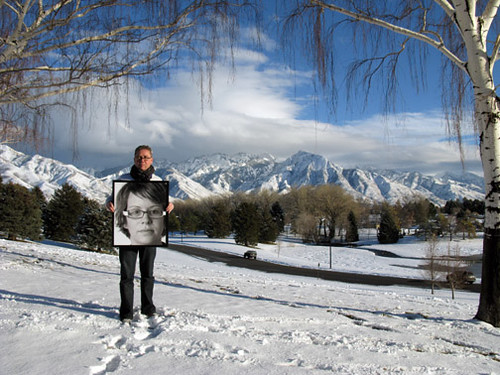
I’m obsessed with the how and where people are installing their Gerz gift portraits, and the relationships they’re having with the portraits.

The outdoor installs are great (from funderbolt):
Sugarhouse_j2

Some are naming theirs (“She looks like an Ashley to me”):
the gift portrait

anna leah says:  I’ve had a blast with this experience. I especially loved seeing the participants walk through the street with portraits in arms. As for mine, I’ve named it “Consuelo”. I’ve had a challenging time and this face says to me, “There’s still hope for you chiquitita.” Now that’s a gift!

IMG_2341

Plus (“installed” on Missed Connections?):

“OK, so we never met but both of our photographs were part of that exhibit at the Moma called the Gift. I went back yesterday and thought I was going to get a picture of myself (and was thinking what was I going to do with a large photo of myself) Instead they all gave us a random photo and I got yours..

If this is your photo and you want it let me know…”

MTAA’s AUTOMATIC FOR THE PEOPLE Posted on February 11, 2009 by Suzanne

A sweet little robot-love interlude during last Saturday’s MTAA performance AUTOMATIC FOR THE PEOPLE (We Solemnly Promise That No One Will Get Naked), while Uni and her Ukelele perform R.E.M.’s Nightswimming, above. Every element of the event was dictated by popular vote, including subtitle, duration, location, audience, costume, theme, props, etc.  As voted by the people, and to be interpreted by the artists, the performance was to take place in the freight elevator; be the exact length of R.E.M’s album Automatic for the People; include lawn chairs, potted plants, & robot costumes; and reference Marcel Duchamp, chat rooms, ukeleles & take-out food. Man, I love these guys. You wish you were here, for serious.  More pics, more video, here.

Jochen Gerz, THE GIFT, installed Posted on February 10, 2009 by Suzanne

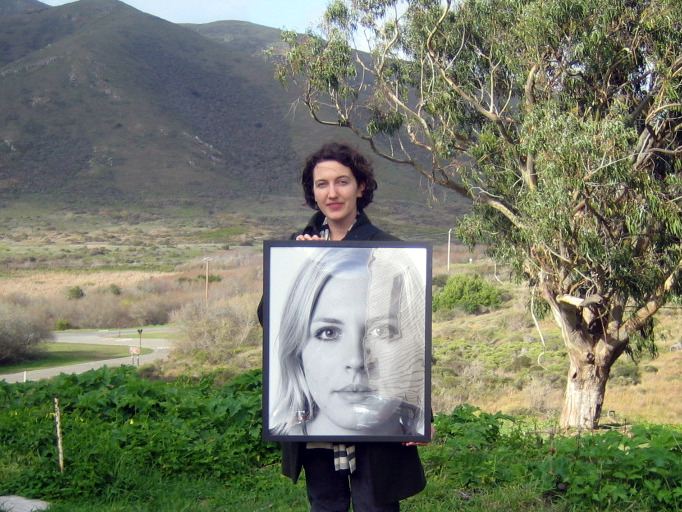
Jochen Gerz was here on Sunday handing out portraits to participants of THE GIFT, and now the portraits are making their way all over town and, one can hope, beyond. We’ve set up a Flickr group for all participants to upload pictures of where and how they’ve installed their “gifts”—do note that participants who sat to have their portrait taken were given not their own picture, but a picture of stranger to take home with them.

Here’s Heidi De Vries, out at the Headlands Sunday afternoon with hers:

jochen gerz, installed
Photo: Aleksandr Vladimirskiy
And the recipient of Art of Participation curator Rudolf Frieling’s portrait made a cell-phone photo essay of Rudolf’s journey “home”:

Rudolf and Friend on Trolley

The rest of this story is here.  More pictures from the closing day giveaway/reception here. A bit more about Jochen Gerz and The Gift here.

**and note: the portrait traveling with Rudolf’s on the cable car (and throughout this journey) is Patrick Hillman, an art student who volunteered as a photographer for the project.***

Posted on February 9, 2009 by Suzanne

Hans Haacke’s News, on November 5th, 2008, when Art of Participation opened:

and on February 8th, 2009, when it closed:

Art of Participation: Closing Day Posted on February 8, 2009 by Suzanne

Janis Joplin said it best: Get it while you can. AoP closes today.

Closing weekend of Art of Participation: Things to, um, Participate In Posted on February 6, 2009 by Suzanne

FREE BEER: 11.20.08Exhibit A: MTAA is going to do their you-voted-it-through performance AUTOMATIC FOR THE PEOPLE (We Solemnly Promise That No One Will Get Naked) tomorrow at high noon. Gather yourselves circa 11:45 a.m. in front of the freight elevator on the third floor, where the performance will take place. If you’re not familiar with MTAA, check out Karaoke DeathMatch 100 “This alcohol-fueled blood feud features 50 rounds of sing-along fury (taped live over an 8-hour period with hardly any pee breaks.)”

Exhibit B: At 2pm, following AUTOMATIC FOR THE PEOPLE, there will be a panel discussion, led by Ted Purves (chair of the Graduate Program in Fine Arts at CCA & author of book fabulously titled What We Want is Free) on “Social Practice West“.

Exhibit Last: ON SUNDAY: from noon until 5pm, come down for the special closing event for Jochen Gerz’s THE GIFT. During Art of Participation more than a thousand SFMOMA visitors had their portraits taken; a number of those have been on view in the museum during the show. For this special reception, Gerz invites all project participants to return to SFMOMA to receive a framed portrait from the exhibition as a gift to display at home:

The last step is to exhibit your piece of the collection, and document how you display it; I’ve set up a special Flickr group for participants of The Gift to share photos (or videos) of how and where they exhibit the portraits they receive.

John Cage: 4′33″: Daily Posted on February 4, 2009 by Suzanne


David Bernstein, Head of Music and Professor of Music at Mills College, demonstrating 4′33″ for staff performers, back in early November. On the piano is the Irwin Kremen 4′33″ score in proportional notation, and behind the piano is Robert Rauschenberg’s White Painting (Three Panel).

[Throughout the run of the Art of Participation, we've been treated to daily performances of John Cage's seminal work 4'33", a composition of silence lasting -- well, yes -- four minutes and thirty-three seconds. A score of 'silence' highlights ambient sounds surrounding the performance. Cage was influenced by Robert Rauschenberg's White Paintings, and together these two works form the opening or entrance to the exhibition. Below, SFMOMA visitor services attendant Michael Zelenko, on what it's been like to experience 4'33" day in and day out, for the last three months. There's also a nice YouTube clip with Cage discussing silence, here.]

4′33″

Once a day, six times a week, four weeks a month, for almost three months…I’ve seen John Cage’s 4′33″ performed at least three dozen times while I’ve been working part-time as a gallery attendant on the fourth floor. Maybe I needed to see it that many times in order to let the whole thing develop, to ripen. My feelings toward the piece have gone from veneration to frustration, fascination to boredom, and finally, in these last few weeks, a return to reverence. I now experience those four-odd minutes as a resting place in an otherwise scattered work day.

Over the weeks, my attention has shifted inevitably from the performance to the audience. On the wide spectrum between befuddlement and admiration, most visitors’ reactions fall somewhere in the middle. However, after a few weeks I realized that those listeners at either end have a common reaction–total and absolute silence. Admittedly, the completely attentive individuals are rare, but they have contributed more than their fair share to my experience. I remember in early December when an elderly Swedish music professor stood riveted next to the piano, intensely focused during those four and half minutes. Afterwards, he shared with me his theory regarding the length of the composition in a hushed tone: the 273 seconds that make up the piece are possibly a reference to -273 Celsius, or absolute zero, when all molecular motion stops, or at least reaches its minimal state, a sort of molecular silence. These audience members –the fans — are my favorite because they stick it out, smile, and applaud warmly when the performer stands up from the bench.

On the other hand, I’ve repeatedly heard the story of a visitor who brazenly tapped a performing staff member on the shoulder, asking for directions. When someone from the audience whispered that they were interrupting, the visitor stepped back in disbelief, as if suddenly awakened. For the most part though, visitors patiently watch the pianist for a couple of minutes before they look at each other and, smiling sideways and shrugging their shoulders,they move on. Others don’t stop at all, but simply throw an awkward glance in passing.

After almost three months, I’d yet to do the honors myself! So it was with excitement that I finally sat down behind that ominous looking piano last week. I have to admit I was a bit nervous. As the seconds ticked by, I began hearing the kinds of things I’d overlooked during all those other thirty-six performances: the droning tones of laughter from Kit Galloway and Sherrie Rabinowitz’s Hole-In-Space or the abrasive sawing of Hans Haacke’s News printer, both installed nearby; and finally, a woman singing, right next to me, in front of Nam Jun Paik’s Participation TV, blissfully unaware she was engaged in two pieces at once, Paik’s and Cage’s. At some point during the third movement, as if orchestrated, all these previously unacknowledged sounds seemed to come together. It felt to me as if the museum itself was performing for us. When it was all over I turned to the audience and heard the pitter-patter of applause, not quite sure who it was for.

——————-

Michael Zelenko lives, works, writes and studies in San Francisco. He is currently a writer for Where magazine.

ANT FARM: Media Van v.08 (Time Capsule) Sealing Ceremony Posted on January 30, 2009 by Suzanne

Here are the guys from Ant Farm, at last night’s Media Van v.08 (Time Capsule) sealing ceremony, recording the video message to the future about the contents of the time capsule. A recap: Since November 5th when The Art of Participation opened, the Media Van’s HUQQUH (that green device with the steering wheel around it, and pronounced “Hookah”) has been capturing digital files chosen at random from museum visitors’ electronic devices (cameras, cell phones, iPods). Those captures are what’s being sealed up in the van (whole van sealed up) — to be accessed again only in 2030.

The men, left to right: Bruce Tomb, Curtis Schreier, Chip Lord [ANT FARM], plus Paul Rauschelbach, who did technical genius on the HUQQUH. (If I’ve got that correct.)

Part of the evening’s festivities also included THIS:
ANT FARM MEDIA VAN v.08 (Time Capsule) Ceremonial Sealing Event

A signed one-page print-out, kind of broadside-style, showing a sequence of some of the four thousand one hundred and eighty-seven randomly captured files. All of the print-outs were different: my copy shows files 2335 through 2370, and each thumbnail includes the date and time of upload, and, in the case of music files, artist and song title. I feel like such a kid: THIS IS SO COOL! Bigger shot here; you can see the thumbnails better.

A few more pics of the event are here.

Erwin Wurm: The balance of desire Posted on January 30, 2009 by Suzanne

Just one more One Minute Sculpture video, to take you to the weekend. All the rest, here.

Erwin Wurm: Keep a cool head Posted on January 29, 2009 by Suzanne

Unsubstantiated office watercooler rumor has it that an especially exuberant visitor tried to fulfill Wurm’s “Keep a cool head” instructions to the letter of the law in ways that are, shall we say, incompatible with current museum policy. More One Minute Sculpture videos here.

And, tonight: The formal closing ceremony for Ant Farm’s Media Van v. 08 (Time Capsule), with Chip Lord, Curtis Schreier & Bruce Tomb in person, starting at 7, right after the Marioni salon. Again with the rumor having it, supposedly a “very famous” person is tonight’s beer-salon guest reader. I have no idea who, as believe me I’d leak it. Which is probably why I have no idea who. See you tonight!

On Letting Them Do It Themselves: Activated Anarchy vs. Designed Intentions Posted on January 27, 2009 by Suzanne

Bay Area artist Stephanie Syjuco weighs in here on the successes and pitfalls of ‘participatory’ art, and takes a close look at New York design firm Freecell’s Stack-to-Fold project, currently in use in our second-floor “D-space“.


“(T)hese objects, once they are assembled, will lend themselves to certain functions, but they might also be reconfigured and used in ways that we can not foresee..Precisely because we might embrace the idea of dysfunctionality-the fact that it becomes more difficult to do something maybe is what makes it more interesting — and provide an open situation.” — SFMOMA curator of media arts Rudolf Frieling

The term D.I.Y., or “Do It Yourself,” has become something of a buzzword lately, an ethos. The acronym was spawned from early 1950s home repair manuals, grew to refer to alternative punk and hardcore music, and now encompasses everything from the burgeoning indie craft scene to the Slow Food movement. Doing It Yourself, it seems, is pretty darn cool because it means you can really “have it your way” and the term wears itself like the ultimate democratic and even populist statement. We are all creators! We are all designers!

However, left to their own devices, humans can be an unruly lot, especially when it comes to following a given set of instructions. Take it from someone who once worked as a designer at a hands-on science museum: a large part of my day was spent trying to design instructions and images to coax museum visitors into doings things a “certain way” (push this button) to get a “certain result” (make it go). The trick was to frame the instruction in a friendly and “rewarding” way that would make the visitor feel they had gained something (“I learned about quantum physics! Neat-o”), or had done something correctly (“I followed the instructions and the whirly thing spun around”). These were the basic goals, with conveying complex concepts falling at one end of the success spectrum, and delivering simple physical results falling on the other.

Mind you, these were the best outcomes one could hope for. What usually happened, comically enough, was a lot of museum visitors randomly banging around on high-tech machinery, buttons being pushed willy-nilly out of sequence, and the lovingly designed graphics ignored and thrown to the winds of instructional irrelevance. What I learned, essentially, is that humans are a messy, anarchic lot that, on the whole — and despite your best-designed intentions — will revert to a herd of cats with incredibly short attention spans.

Of course I’m being more than just a little cheeky here. For every fifty people who “do it wrong,” (or don’t do it at all) the one person who does it “right” may really get the right “something” out of it. And who says there’s no success in eliciting joy from randomly pushing buttons anyway? What is right, anyway? And what is, for lack of a better term… wrong?

Initial Freecell design proposal photographs
All of this is a rather long-winded way to begin a rumination on design group Freecell’s Stack-to-Fold , commissioned by SFMOMA for the Participation exhibition. Visiting on a crowded Free Tuesday at the museum last week, I encountered gorgeously designed cardboard panels available in the museum’s D-Space area for visitors to punch out (they are perforated) and assemble into different modular types of furniture-like structures: bench-like things and wedge-like table-things. Depending how the assembler wanted to interpret it, each person could design for themselves different useful components out of basic building blocks: perhaps a bench to sit on to watch the movies being projected in the space, or a comfy corner to sit against, or perhaps a platform to peruse a book on. In a prior blog interview the designers touched on the notion of dysfunction as inherent in their design setup and this is what intrigued me the most during my observation of their installation.

How do designers and viewer/participants gauge “success” when it comes to open-ended or participatory experiences? Especially when the viewer/participant is called upon to follow a given set of rules but also to bring in their own creativity (or even lethargy) and possibly do something unforeseen or deemed “unruly” by the designer? In other words, are all outcomes — especially the ugly — ones… good? Does inviting someone to respond to a work only to have them merely scribble graffiti on it a valid invitation-response exchange in itself? Should designers nod approvingly when their works get turned upside down? To take a well-known and ongoing online example, I wonder how much of the “crappy” or “wrong” responses end up online at the “Learning to Love You More” website by Harrell Fletcher and Miranda July and how do they get weeded out as so? I assume that not every response is deemed a “right” response.What an artist/designer hopes for is a response to their solicitations for participation. But I suspect they also expect something in particular. How does a sliding scale of success become formulated?

OK, back to the unruly public:

I can appreciate when the best of intentions goes a bit haywire. Structured (or even semi-structured) situations like Freecell’s project have the potential to elicit the most interesting and off-the-wall end products simply because the public responses defy expectation.

I feel for anyone in the designer’s situation who finds themselves inviting a type of open-ended response but may also have a rather specific vision of what they want the outcome to be. As someone who has also tried her hand in projects that elicited outside participation, it was an interesting personal barometer as to what I deemed “acceptable” as a result. I have been both amused, shocked, and humbled by the off-the-wall end-products generated. The Counterfeit Crochet Project solicits crafters all over the world to hand-make designer products and then send me photographs of the results. These have ranged from stunning feats of verisimilitude and skill to the most banal or strangely made objects. And while I’ve been impressed at the “good” ones (interesting proposition: can you really counterfeit “correctly”?), it’s the “bad” results — the lumpy mistranslations, the not-so-perfect outcomes, the Christmas ornaments, doilies, and non-designer results that actually give me more insight into the real customized DIY experience, one that reflects personal tastes, concerns, and a “this is what I want to do, not so much what you want me to do” attitude. In the end, I keep all the results, promise to show all the items in some way, and have learned that you never can tell how people will interpret your proposition.

Left: original image of Coach handbag. Right: counterfeit crochet version, never finished, by Carrie Suchman from Ohio.
Institutional limitations

Suzanne Stein, SFMOMA community producer, pointed me in the direction of this video snippet showing SFMOMA visitors using Lygia Clark’s interactive work Rede de elástico (Elastic Net) as a jump rope in the galleries. This work requires visitors to collectively knot together individual rubber bands to create a “net” of sorts; life as a jump rope was unexpected and had to be quickly discouraged as it may have interfered with or bumped into other works in the gallery. To be fair, in an earlier Open Space blog interview, Art of Participation curator Rudolf Frieling acknowledges that there are always institutional restraints that keep artworks from getting too unruly and that may even hinder a fully “active” participatory experience. Clark intended her work to be actively played with. It’s just that SFMOMA can’t accommodate all the ways in which that can happen.

“There is a famous historic example of an exhibition by Robert Morris in 1971, at the Tate in London, that had to be closed after a few days because people were destroying some of the objects. There is an urge and an eagerness to do something and to participate that can be counterproductive to the usual aims of a museum.” – Rudolf Frieling

Freecell’s initial plan was devised for a minimal room with no other furniture in it, in which visitors could construct the modular units. But “D-space” is also the Koret Visitor Education center, and purity just wasn’t possible: Stack-to-Fold bumps up against a video projection area, and coloring/drawing area (The 1000 Journals Project), creating a bit of confusion as to what one is supposed to focus on or pay attention to. As the exhibition progressed, it was also apparent to the museum staff that folks weren’t utilizing the space “correctly” by making their own seating area and tables out of the Freecell units, so they added actual chairs and a formal sitting area with tables. This may have discouraged folks even more from thinking of their constructions as functioning as utility items. From my visit, it looked as if the Freecell units had become surfaces upon which to graffiti on or stack like Legos. It certainly looked like a far cry from the clean, platonic, designed experience originally depicted in their mock-ups.

The Participation show, and the Freecell project in particular, invites viewers to take part in a specific set of circumstances; artists/designers as well as the museum then have to stand back and hope that they have constructed a proposition that is both contained yet still open to interpretation. What’s interesting to me are the divergences that occur, the trajectories and unruliness that can come about from the public choosing to reinterpret or even ignore a given set of conditions within a participatory artwork and just “do it themselves” in their own way. Also, actual institutional circumstances (space constraints, budgets, etc) can hinder the execution of a “pure” vision. I’m curious if there’s such a thing as “failure” in these types of works, and if so, how do we evaluate this? As artists and curators, we try to frame our participatory proposition to the best of our abilities, and then it is up to us to step away and watch what happens when set upon by that fabulous, inventive, unruly, and chaotic public. Whether we like it or not.

……………………………………………………………………………

Stephanie Syjuco is a visual artist based in San Francisco. Working primarily in sculpture and installation, her objects mistranslate and misappropriate iconic symbols, creating frictions between high ideals and everyday materials. You can view her work at http://www.stephaniesyjuco.com.

Erwin Wurm: Sigmund Freud’s Dream Posted on January 26, 2009 by Suzanne

Happy Monday! What did you dream about this weekend? Come down and try it yourself. More on Erwin Wurm & the One Minute Sculptures just below.

Tomorrow! Bay Area artist Stephanie Syjuco, on DIY cardboard furniture, and ‘participation’ in art museums…

Erwin Wurm: The trap of the truth Posted on January 22, 2009 by Suzanne

As the Art of Participation exhibition winds down — or ramps up to wind down and close ( Feb. 8 ) — we’ll be posting up a series of text & video of various kinds of interaction, examination, and reflection on the participatory experience at SFMOMA. Following on from last week’s investigation of How Do You Participate with an Ant Farm Media Van, we also did a set of test-cases with Erwin Wurm’s One Minute Sculptures. These sculptures present a series of objects on a platform, with text instructions and picture diagrams indicating what you’re to do in order to enact the sculpture: for one minute. A very nice line from Kathrin Herzog at ArtFacts.net: “Contrary to Duchamp, Wurm designs not readymades, sculptures fixed into an unchanging form, but works that are constantly ready-to-be-made.

We’ll have more of these in days to come. In the meanwhile, as it turns out, the Red Hot Chili Peppers are Wurm fans too. Here’s their take on his deal:

[update! less than 24hrs later, video pulled from YouTube for copyright claim. Bummer. Here’s the Wikipedia entry on the song & the video, and here’s a “Pretty Cool People” interview with Wurm.

ANT FARM Media Van v.08 (Time Capsule) Posted on January 15, 2009 by twiceastammy

Dear reader,

This is Tammy. Sorry it’s been so long since my last post. You might think I’ve been laying low — just kicking back on autopilot on some tropical island with the man or woman that I love. But no way! I’ve been sitting right here in this cubicle, in this chair, in the exact same position, for weeks now. So when Suzanne asked me if I would go on assignment in the galleries to cover the public’s interpretation of the many participatory pieces in the enigmatically titled exhibition, The Art of Participation: 1950 to Now, well, I was thrilled. Lucky for me, Megan Brian offered to help. (She’s the kind of person people instantly open up to.)

Our mission was simple: “How does this thing work?” The first object under our studious lens was Ant Farm’s Media Van v.08 (Time Capsule), a gutted van with hookah-styled plug-in station for uploading digital files from your own phone, camera or iPod:

The electronic time capsule will be soon be sealed, to be opened again (‘accessed’) only in the year 2030: CLOSING CEREMONY FOR THE ANT FARM MEDIA VAN V.08 (TIME CAPSULE): January 29, 2009 7:00 p.m. – 7:30 p.m.: Chip Lord, Curtis Schreier, and Bruce Tomb in person. FREE! (with museum admission…)

Something you just won’t see everyday: Posted on December 12, 2008 by Suzanne

SFMOMA director Neal Benezra, with Elaine McKeon, tending bar in the Koret Visitor Education Center, for last night’s Marioni salon:

FREE BEER: 12.11.08

FREE BEER: 12.11.08

FREE BEER: 12.11.08

Tom Marioni; SFMOMA exhibitions design manager Kent Roberts.

FREE BEER: 12.11.08

Tammy Fortin; Kent Roberts

All pictures: Chris Brennan.

Many many more pictures of last night’s salon are here.

Tonight’s FREE BEER Guest Bartender? SFMOMA director Neal Benezra. Posted on December 11, 2008 by Suzanne

For serious.

Tonight’s guest bartender at Tom Marioni’s salon is none other than SFMOMA director, Neal Benezra. And not only that, but Neal will be joined in his labors by long-time SFMOMA trustee and former chairman of the board, Elaine McKeon. It should be said that, among Ms. McKeon’s many leadership credits, it was she who recruited Neal from the Art Institute of Chicago in 2002. Also, she wears fabulous outfits.  I’m looking forward to seeing this pair’s prowess behind the bar.

Tonight’s all-star cast ALSO includes SFMOMA exhibition design manager & chief preparator of nearly thirty years, Kent Roberts, as the evening’s reader. Not to be outdone by Neal, Kent is bringing along his own sidekick, media arts assistant & Open Space regular, Tammy Fortin, who for certain won’t let herself be outdone by Elaine in the get-up department. Plus, she’ll be playing the drums.

ALSO on tonight: novelist Michael Cunningham and designer Martin Venezky will talk about their collaboration on a limited-edition double deck of cards (design by Venezky, text by Cunningham), commissioned by SFMOMA in conjunction with the exhibition Double Down: Two Visions of Vegas. They’ll be joined by Henry Urbach, Helen Hilton Raiser Curator of Architecture and Design. Free with admission; Wattis Theater, 6:30pm. SEATING IS LIMITED.

Tonight! Beer, surveillance, border crossings, chalkboard music Posted on December 4, 2008 by Suzanne

Hey all,

Just a reminder that tonight’s Tom Marioni FREE BEER Salon is featuring that famous local painter Robert Bechtle as guest bartender, and that famous local news & gossip maven Leah Garchik as guest reader.

Also on tonight in the D-Space, starting at 7pm when the salon closes, is a cool-sounding project developed by Stanford students as part of our experiment Group Work, a collaboration between three types of institution: an art school (CCA), a research university (Stanford), and a modern art museum (that’s us). Peggy Phelan at Stanford, and Brian Conley at CCA, have been leading courses on art education and participation, and as part of their coursework, each student group is producing projects related to those themes. Tonight the Stanford group presents, and next Thursday the CCA group will be here.

Details from the Standford students:

We imagine a lively atmosphere with eccentric sounds, people in puppet clothes, photographs (like at an amusement park), and occasional readings of esoteric materials. An art-town fair with three main elements:

Collaborative soundscape Two chalkboards with contact microphones attached placed on opposite sides of the room on easels. Chalk and erasers are provided. The sound will be amplified, and processed with effects like reverberation, distortion, and delay. The effects and prerecorded sounds will be controlled from two laptop computers stations operated by the students. The piece emerges from the collective writings and drawings of participants from the public, and momentary interventions or sound poems written by Stanford students. Other sounds such as erasing or directly touching the chalkboard will add nuance. In addition to the live sounds from the chalkboards, there will be some sporadic instances of prerecorded material, realized by the students &  emerging as performance cues. The audience is confronted with an object that is familiar as a pedagogical tool, but transformed into an instrument that invites creative personal visual and aural experiences while participating in an open sound piece.

Border piece: Built on the fourth wall of the D-Space between the two front columns, approximately 4 feet high, this element constitutes a barrier/border fabricated out of fine, breakable threads, yellow DO NOT ENTER, DANGER, CAUTION tape, tie-line, clothes pins, & “surveillance” cameras. The barrier will have rotating on-duty “staff.” Participants have a few choices for passing through: 1. ­ pass trough this border by making an offer, write a poem, make a small drawing, a dance movement, etc., OR 2. ­ create a new identity by using provided elements for a new kind of identification card. Once realized the ID constitutes a “legal” document and can be used as a pass, OR 3. ­ do none of the above and find a way to “cross” the barrier/border “illegally,” by crawling or jumping over. On the other side of the border lies the FUTURE, a place for play and display of inclusion and exclusion, of exploration of all six senses.

Polaroid piece; Three Polaroid cameras, three disposable cameras, and two photosticker cameras will be placed around the room. Each camera will have instructions or a prompt such as, “with this camera shoot the person you find the most attractive tonight,” or “make a political statement with this camera” or “please take home the picture you took with this camera and send it to a person who does not know what collaborative art is” or perhaps simply “capture participation.”

If all this isn’t enough (or is too much) for you, there’s also a screening of Derek Jarman’s Edward II, starting at 7pm in the Wattis.

Call for experts in the impossible: this Saturday Posted on November 24, 2008 by Suzanne

If you’re around this holiday weekend and harbor both a special talent for achieving the impossible and the lecturing skills to teach someone how to achieve that miracle themselves, a group of SFAI graduate students wants to hear from you. In conjunction with The Art of Participation, they are organizing an “Art of How-To: Intuitive, Impossible, and Absurd” mini-lecture hour in our Koret Visitor Education Center (slash “D-Space”) on Saturday afternoon, inviting you to come down and educate the public with your special wisdom. Everyone’s welcome to propose a topic, and selected presenters will be given five minutes to discourse. They’ll be shooting video and it’s possible we’ll post some of the results here on the blog.

Contact info and more details are here.

free hangover Posted on November 14, 2008 by twiceastammy

Dear reader, this is Tammy.

Last night, as part of the ongoing exhibition The Art of Participation, SFMOMA hosted the first in the series of the Tom Marioni salons: The Act of Drinking Beer with Friends Is the Highest Form of Art. Bringing this simple act into a museum setting required the building of a bar (which I am petitioning to keep well-stocked beyond the show) in the Koret Center, ordering twelve cases of Pacifico beer from the local Bevmo, the completion of many pink and green logistics forms, the administration of drink tickets, and the acquiring of a bartender for each night. Last night’s barkeep was Curator of Media Arts, Rudolf Frieling. It was a special occasion, as it is the only time I’ve ever ordered a beer from my boss.

The place filled up quickly with friends and we all drank (with gusto). We were doing it! We were creating art and I could feel it: tiny carbonated bubbles and a general loosening of the seams. The game of quarters was not attempted, but the idea was bandied about. Tom Marioni walked to the podium and gave his address. He was loaded–with jokes. And read with a slight impish nature. A poet appeared on the scene. He had a sign that read “Poems for Sale.” I handed him a dollar. He asked, “What would you like a poem about?” I thought and said “A dark window.” He licked his lips, took a glug from the bottle and began typing on his little typewriter. He finished and handed me a slip of paper with my poem on it. It read:

mac
book
night
dot com
aka wall

Well worth every cent!

The next salon will be Thursday, November 20th at 5pm. Anne Colvin is bartending, Bill Morrison is the guest reader. I hope you can make it.

FREE BEER! Posted on November 13, 2008 by Suzanne

For serious, I have been waiting to post that headline for over a year.  Starting tonight! and for the next three months, we are hosting Bay Area conceptual artist and sculptor Tom Marioni’s weekly salon, The Act of Drinking Beer with Friends Is the Highest Form of Art. If you’re not familiar with this work, Tom has been organizing these salons, where friends and artists can convene, converse and drink beer, in his studio and elsewhere, for more than two decades.

Each week we’ll have special guest bartenders and readers, & I’ll try to keep you apprised: tonight’s bartender is Rudolf Frieling, Curator of Media Arts, and the reader is Mr Tom Marioni himself. Do come by! It’s free, with museum admission of course; keep in mind that space is limited (see below). Entry will be on a first-come, first-served basis. Like any drinking establishment, you must be over 21 & carrying vaild ID.

Here’s Tom’s FREE BEER sculpture as we have it in our collection (and as you can see it on view now on the fourth floor as part of AoP)—the piece is made from the detritus of the salon as it was exhibited/hosted here at SFMOMA in 1979:

Tom Marioni, FREE BEER (The Act of Drinking Beer with Friends Is the Highest Form of Art), 1970-79; refrigerator, framed print, shelf, beer bottles, and lightbulb, installation view at SFMOMA; collection SFMOMA; photo: Ben Blackwell; © 2008 Tom Marioni
Here’s the bar set-up in the Koret Vistor Education Center, ready for bartenders to dispense FREE BEER and for art lovers and friends to drink it happily and I hope noisily together:

And here are the still QUITE EMPTY (as of today) shelves which will hold and store our many emptied bottles of beer:

No one lacks expertise in this particular form of art, or if you do, now’s a great time to hone your skills. Come on by, or, we hope to see you soon!

Art of nearly participating Posted on November 11, 2008 by Suzanne

Hey! It’s Masanori Mark Christianson, bass guitarist for Oakland’s indie rock band, The Heavenly States,  dangling Lygia Clark’s Diálogo: Óculos (Dialogue: Goggles)

Photo by Cynthia Mott.

Hey facebook, where I found this pic. Thanks, Mark!

Interview: Rudolf Frieling on The Art of Participation. Part II Posted on November 6, 2008 by Suzanne


Tom Marioni, The Act of Drinking Beer with Friends Is the Highest Form of Art, 1970 – 2008, 1979 installation view at SFMOMA; © 2008 Tom Marioni; photo: Paul Hoffman
Part two of my conversation with Curator of Media Arts, Rudolf Frieling, on The Art of Participation. Yesterday we covered some specific projects in the exhibition and what an ‘art of participation’ might be; today we’re talking about the build-it-yourself cardboard furniture in the Koret Visitor Education Center, and the particular challenges and delights of putting on an exhibition like this one in a museum setting.

Let’s start with the transformation of our Koret Visitor Education Center and the Freecell commission. For the run of the exhibition, the ed center is being turned into something called “D-Space.” Can you talk about that?

One thing that is really key to this whole project as an exhibition is that we want to explore what it could mean for the museum to be not just a container for artworks, but actually a producer, or a site of production. And we’ve been thinking about the practice of institutional critique many artists developed in the 70s and 80s which in part involved leaving institutional spaces and going into alternative spaces, and the way some contemporary artists work in different kinds of social space, perhaps educational spaces, blurring the distinctions between them. In a museum we normally have a clear distinction between what is gallery space, what is social space, and what is educational space, and this is something that many contemporary artists would certainly want to challenge.

So, if I understand you correctly, you’re talking about a way we might mirror artistic practice, by attempting to blur the boundaries between the education spaces, the lecture halls, and the galleries of our own institution.

Right. My initial concept was to create a core zone, an open educational and performative space, right at the center of the whole show in the fourth-floor galleries, but for logistical reasons we had to relocate to the second floor, to our current educational center. So we thought, well how can we take the spirit of the show into that space and transform the space? We can ask artists to interpret that situation and to provide a different solution. We wanted to have a space that could be transformed by visitors, also by staff members, and be transformed for different uses, different functions, with the idea being that it could always be set up differently and so always provide a different experience.

Based on who was using it and for what purpose.

And you would never know quite what to expect before you get inside. So we asked an architectural and design group in New York, Freecell, to design pieces of furniture or some kind of reconfigurable structure based on a do-it-yourself model. They came up with a series of cardboard panels with perforations and instructions, to be folded into furniture. In the beginning they will be just rectangular shapes leaning against the wall, in an empty room, almost like pictures in a gallery, but that are to be taken off the wall and used, turned into something else-that is a truly participatory act.

(more…)

Interview: Rudolf Frieling on The Art of Participation Posted on November 5, 2008 by Suzanne


Matthias Gommel, Delayed, 2002; closed-circuit sound installation; photo: courtesy the artist; © 2008 Matthias Gommel

A few weeks back I had the chance to talk with Curator of Media Arts Rudolf Frieling about The Art of Participation: 1950 to Now, rolling in this Saturday. The exhibition looks at ways artists have been engaging audiences as collaborators in the art-making process over the last sixty years; of its many distinctive features, “AoP” (as we’ve been short-handing it back of house) will change form and content as people contribute to it. I wanted to ask Rudolf some specifics about the exhibition, and also get his take on what happens when you try to set a big, mutable, participatory exhibition down in an institutional setting a tiny bit more used to the object-on-wall approach than double headsets & DIY cardboard furniture. It was fun, & we talked a lot: I’ll post this in two parts, today & tomorrow.

—-

Rudolf, let’s start by my asking a very basic question: what is an “art of participation”?

That is my question as well, and really the question we are exploring with this exhibition. We know what it means to participate in politics or school, and sometimes know what it means to participate in a work of art if we get clear instructions. However there are some projects where it is unclear what exactly is asked of you, or you can only find out by actually doing something. The work requires your input and your act of contribution.

But the term can also mean an open situation. The idea of “the open work of art” goes back to a 1962 book by Umberto Eco, in which he reflects on developments within contemporary art and music where the results of the artwork were not predefined, but rather could change over time, or change by interpretation. He said, in the whole history of art, the act of looking is a kind of interpretation; it’s always different and each one of us sees art in a different way. In this exhibition, we’re interested in ways people can contribute to a work not only by looking—but also by interacting, participating in a group dynamic, or contributing to an artwork. We go, in other words, beyond the viewer.

What does it mean in this context to contribute or participate? Is it a physical action or something else?

Let me give you two examples that are quite physical. The artist Lygia Clark is a pioneer of what we would call today relational aesthetics. I believe she invented the term “relational objects” –objects that relate to people, to each other, or to a group of people. One example is a net made of rubber bands. There are no specific instructions for use, but together with other people you can test the possibilities of the net. You can stretch or play with it, in a joined, cooperative initiative. By doing this with others, you are dependent on the dynamics of the group; this could lead to something very deeply felt and intense, or it might not even work; for example, if you can not communicate with anybody.

(more…)

No thing. Not anything. Naught. NOT YET. Posted on October 28, 2008 by Suzanne


This is a portrait studio if I say so.
Doesn’t look like much, does it?

It will. This pair of empty desks and chairs tucked into a corner of the third-floor landing will shortly become the portrait studio for Jochen Gerz’s project THE GIFT, part of the upcoming exhibition The Art of Participation: 1950 to Now, which—I’ve been writing this paragraph for three hours trying to convey my true exhilaration at the nearing prospect of! In super brief: the exhibition examines ways artists have been engaging audiences as essential collaborators over the last sixty years, covers a whole wide range of genre and media, is so much of what this correspondent loves in contemporary art, and promises to be a lot of FUN.

The image I have in my mind of what happens when AoP opens the morning of Nov 8 is something like hundreds of squealing eight-year-olds flooding the Atrium, the stairwells, the galleries, and immediately transforming those spaces with their infinitely renewable bright excitable energy. A somewhat undignified way of introducing this important, layered survey of participatory art practice, but nevertheless a gesture toward some of the very human, relational, and tangible experiences I think the exhibition hopes to provide. The infinitely renewable, excitable eight-year-old of my heart wants to tell you EVERYTHING about the exhibition, ALL AT ONCE, RIGHT NOW! and in coming days and months you’ll hear a lot about it on the blog, starting with a (more) dignified interview with The Art of Participation curator Rudolf Frieling next week. But for today, just a quick sneak peek at Jochen Gerz’s The Gift:

Jochen Gerz, The Gift, iteration SFMOMA 2008. The gallery wall awaiting your image; ‘photo studio’; and picture-storage wall-o-cubbies. Those cubbies are big enough for whole teenagers to stuff themselves inside of, according to exhibitions manager Kent Roberts, who caught half a high-school class doing same.
The idea is that at the beginning of the exhibition there is literally nothing on the wall. With your collaboration, and with a lot of help from students and volunteers from around the Bay Area, The Gift will be produced over time. We’ll use the photo studio to take portrait pictures of museum-goers which will then be printed, framed, exhibited, and stored all on the same floor, all on view. Gerz’s work is called The Gift because you give your picture to the show, & because you also get something in return: on closing day, we’ll have a big communal event (a.k.a “a party!”), and the artist will hand out a picture to everyone who contributed theirs to the project.  In other words, if you have given your portrait, you will then also own a part of the collection. You don’t get your own photo, however; you get a picture of a stranger, and the condition of receiving a portrait is that it then gets exhibited elsewhere (BART station/your living room/your tropical vacation?). Portrait sittings will be on a first-come, first-serve basis, when the studio is open (tentatively 12-4 M-Tu-Th-F). Also look for big spreads of visitor portraits in local newspapers over the run of the exhibition, also orchestrated by Gerz & part of the project, and another way of extending the artwork into the daily life of the city in ways that aren’t specific to the museum walls. Or even, exactly, SFMOMA’s jurisdiction. More on this in future.

Jochen Gerz, The Gift, 2000; digital photography studio, production lab, digital pigment prints, and newspaper advertisements, each photograph: 23 5/8 × 19 11/16 in., overall dimensions variable; installation view at Le Fresnoy, Studio National des Arts Contemporain, Tourcoing, France, 2000; photo: courtesy the artist; © 2008 Jochen Gerz and Artist Rights Society (ARS), New York/VG Bild-Kunst Bonn, Germany
In the meanwhile: More on The Art of Participation here. Members’ preview opening is FRIDAY NOV 7, adjunct to Martin Puryear, with everything open to the public November 8. Become a member! Come to the party! It is going to be a lot of fun. And for months to come.

xxoo!

SS