Home is a four letter word. Posted on August 14, 2009 by Adrienne Skye Roberts
Lately I’ve been thinking a lot about home. These thoughts travel from my recent curatorial endeavors, to my involvement with tenants rights in San Francisco, to my unrelenting personal investigation into my role as a young, white artist in the Mission District. Of course, the housing crisis and economic recession has everyone thinking about home and property; whose homes are valued and therefore protected, and consequently, who is valued. (There is much more to be said about this and recent local legislation that exposes the vulnerability of renters, however this may not be the place). To consider home as solely attached to the built structure of a house is a limiting definition. Home means to belong to a people as much as it does to place. It is the accumulations of actions and experiences in one place. It is also a contested site; a place many people must distance themselves from and a destination we are often searching for.
In this post I briefly discuss five artists—some internationally known and others local and emerging—whose work investigates home in one way or another. I refrained from discussing Rachel Whiteread’s “House” or Gordon Matta Clark’s “building cuts” although both projects are important examples of site-specificity and architectural interventions that address issues related to home. Only one artist featured below speaks directly to today’s housing crisis, however they have all been influential for me in considering the multiple ways to define and understand home.
Josef Jacques: Gateway to Yosemite

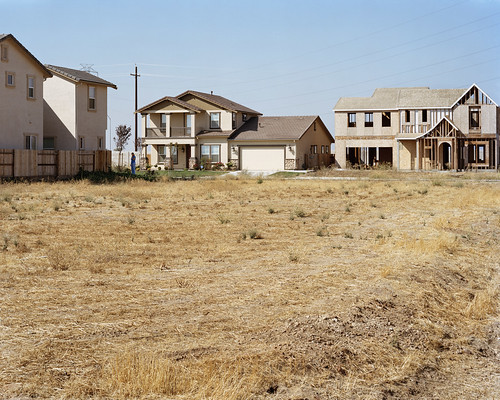
Josef Jacques, from the series “Gateway to Yosemite” documenting the incomplete subdivisions in Merced, CA.
In his series Gateway to Yosemite, Josef Jacques photographs the city of Merced, located 50 miles from Yosemite National Park in California’s San Joaquin Valley. Merced was hit especially hard in the housing crisis. In 2005 it was considered prime real estate with the construction of the new University of California campus, however as the prices of homes dropped, investors, developers, and subsequently, many families left the area. Many subdivisions still await completion; some houses are lived in and others show signs of vacancy, such as dried up lawns and incomplete construction. Merced was a popular destination during the California Gold Rush and Depression era migrations—a history that makes Jacques’ documentation of the city in limbo all the more haunting, as it is a city that seems to still be waiting to fulfill its promise.